
What granite is
Wikipedia's granite article describes it as a coarse-grained igneous rock made mostly of quartz, alkali feldspar, mica and plagioclase. It forms when magma rich in silica cools slowly underground, which gives the crystals time to grow large enough to see.
Those visible crystals are the speckles people notice in a granite counter. Light grains are usually feldspar and quartz, and the darker flecks are minerals like mica. Because the stone formed naturally, no two slabs are exactly alike, even when they carry the same trade name.
Granite is an old building stone
Granite has a long history as a building material. The same Wikipedia article says the granite and marble trades are among the oldest industries, going back to Ancient Egypt, where granite was used for columns, door lintels, sills and wall and floor veneer.
It has also been used for monuments, public buildings and flooring tile. Kitchen counters are a much newer use, but the qualities that made granite useful in old buildings, hardness and a polish that holds up, are the same ones people look for in a counter today.
Not every "granite" is true granite
Stone yards use the word loosely. Wikipedia notes that in the construction trade "granite" often also covers other intrusive rocks such as gabbro and diorite, and that the stone sold as "black granite" is usually gabbro, which has a different chemical makeup.
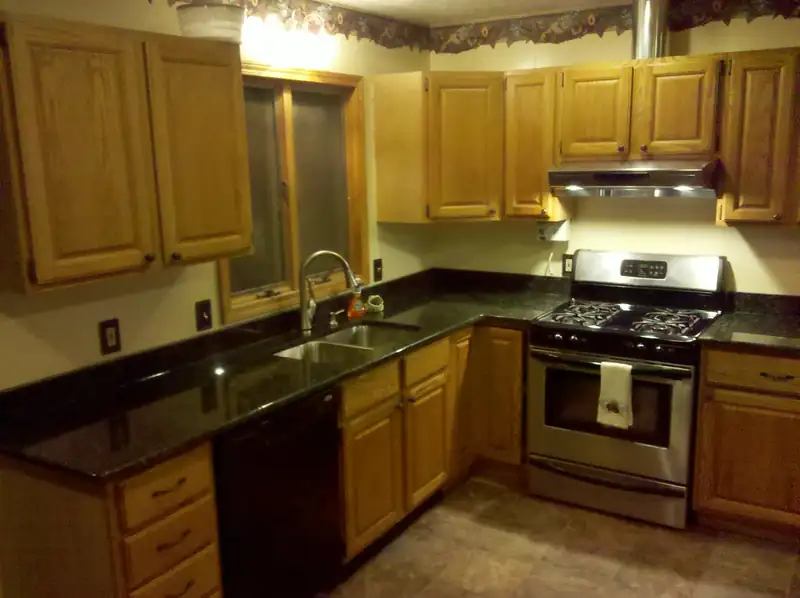
That does not make those stones a bad choice. It does mean the name on the sample tag is a trade name, not a lab result. If care matters to you, ask the stone supplier what the slab is and what they suggest for sealing and cleaning that exact stone.
Colors and patterns
Wikipedia says granite is mostly white, pink or gray, depending on its minerals. In stone yards you will also see tan, gold, brown, green, blue and near-black slabs, plus stones with long sweeping movement instead of an even speckle.
A busy, speckled granite hides crumbs and water spots well, which some families like in a hard-working kitchen. A quieter slab lets a patterned backsplash or bold cabinet color be the focus of the room. Both are good choices; it depends on what else is going on in the space.
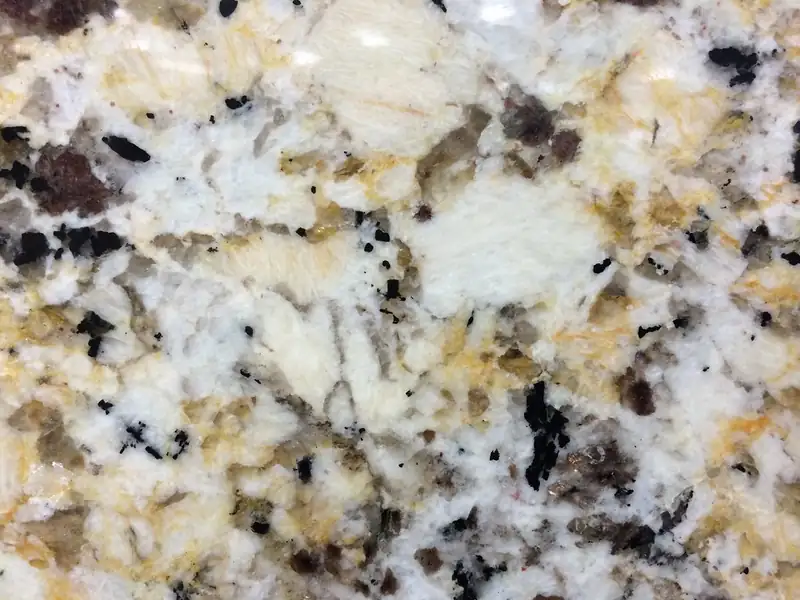
Bring a cabinet door and a floor sample when you look at slabs, and see the whole slab when you can. A small chip rarely shows how the pattern moves across a full island.
Polished, honed and leathered finishes
Polished granite is glossy and reflects light, which brings out the color and depth of the crystals. It is the finish most people picture.
Honed granite is ground flat to a matte surface. It looks softer and more modern, and it hides fine scratches, though it can show fingerprints and oily marks more than a polished top. Leathered granite has a slightly textured feel, somewhere between the two.
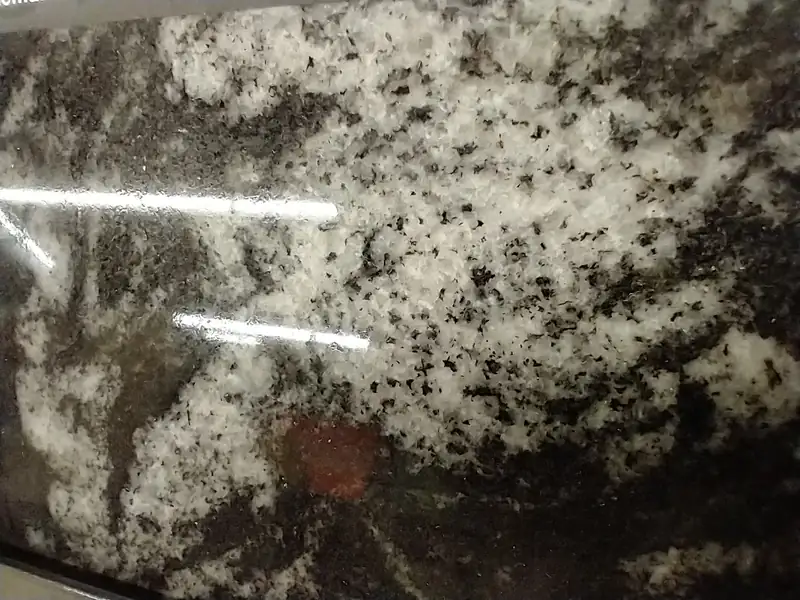

Ask to see each finish on the same stone. The finish can change how dark a slab looks by quite a bit, especially with black and deep green stones.
Sealing and everyday care
Granite is natural stone, and many granites are sealed to help them resist stains. How porous a slab is varies from stone to stone, so ask the supplier whether your slab needs sealing and how to tell when it is time to reseal.
For daily cleaning, warm water and a mild, pH-neutral soap are a safe habit. Wipe up oil, wine and citrus instead of letting them sit, and skip harsh or acidic cleaners that can dull the surface or wear down a sealer.
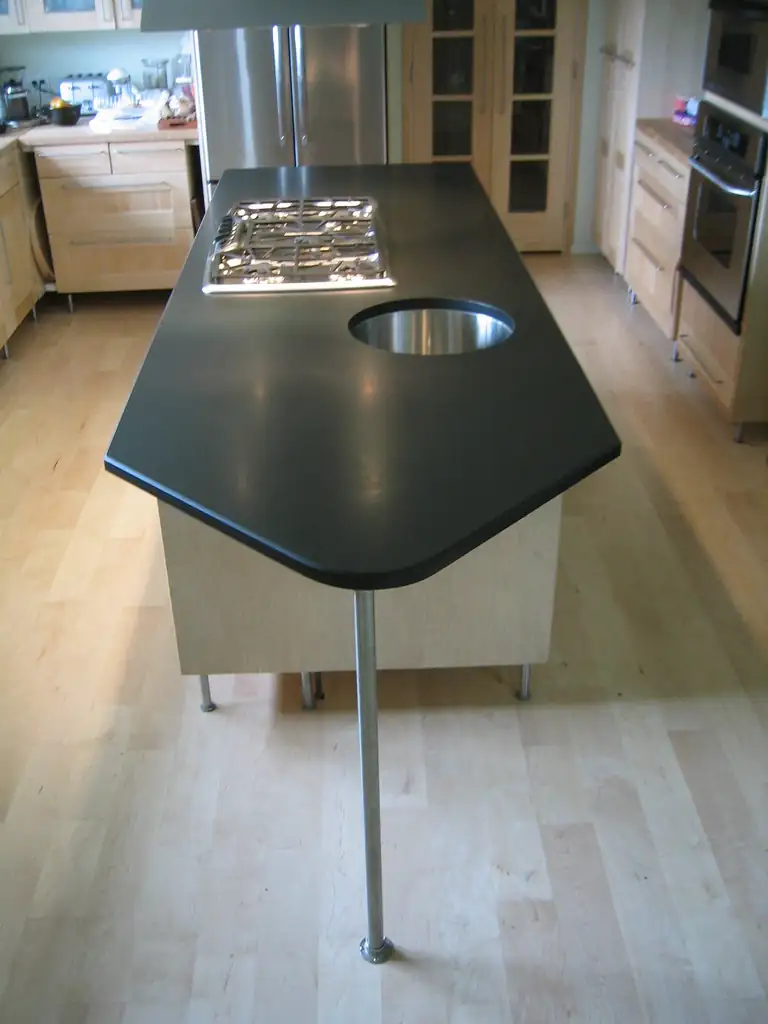
Granite handles heat better than resin-bound engineered stone, but a trivet is still a good idea for pans straight off the burner.
Granite in bathrooms
Granite works on vanity tops as well as kitchen counters. Soap, toothpaste and makeup are easier to wipe off a sealed, polished top. For vanity sizes, sinks and lighting, see the vanity and lighting guide, and for tile around the vanity, see natural stone bathroom tile.
A single vanity uses a small piece of stone, so remnants left over from larger slabs are worth asking the stone yard about.
Where the counter fits in a remodel
Counters come after the cabinets. The cabinets need to be set and level before a fabricator can template the stone, and sink, faucet and cooktop choices need to be final because the cutouts are made from them. Our small kitchen refresh guide covers what changes when only the counters and backsplash are being replaced.
For the full picture, see kitchen remodeling and bathroom remodeling, plus the local pages for kitchen remodels in Rosemead and countertop replacement in San Gabriel.
Granite next to quartz and other counters
Granite is often compared with quartz, which is engineered from crushed stone and resin. Quartz gives a more even color from slab to slab and generally does not need sealing. Granite gives one-of-a-kind patterns and is natural stone through and through.
Wikipedia's article notes that granite is a popular counter choice in the United States for its look and its natural acid resistance. If you want warmth rather than stone, butcher block is the other common option, and a tile backsplash can tie any of them to the rest of the kitchen.
A simple way to decide is to list what matters most in your kitchen: an even color, a one-of-a-kind pattern, low upkeep, or tolerance for hot pans. Then look at real slabs of each with that list in hand. The right answer for a busy family kitchen may be different from the right answer for a powder room vanity.
More materials and styles
- Sage, terracotta and deep blue cabinets
- Butcher block countertops
- LVP vs tile flooring
- Victorian tile
- Basketweave tile
- Mosaic tile
- Quarry tile
- Stacked stone
- Hexagon tile
- Terrazzo tile
- Herringbone tile
- Backsplash tile ideas
- Shower tile ideas
- Quartz countertops
- Spanish tile bathroom
- Saltillo tile
- Zellige tile backsplash
- Talavera tile
- Cement tile bathroom floor
- Terracotta tile floors
- Bathroom color trends
- Porcelain wood-look tile
- Subway tile vs handmade tile
- Porcelain vs ceramic tile
- LVP vs laminate flooring
- Semi-gloss vs satin paint
- MDF vs wood trim
- Natural stone and marble bathroom tile
- Grout types: cement, epoxy, urethane
Planning the whole room? Read our remodel guides, starting with how to choose bathroom tile.