
Postwar rooms
Wikipedia describes rapid growth in Monterey Park after World War II, with many new subdivisions. Houses from those years were often built with no crown at all.
That leaves a clean slate for a simple, well-fitted profile.
Crown on a tray ceiling
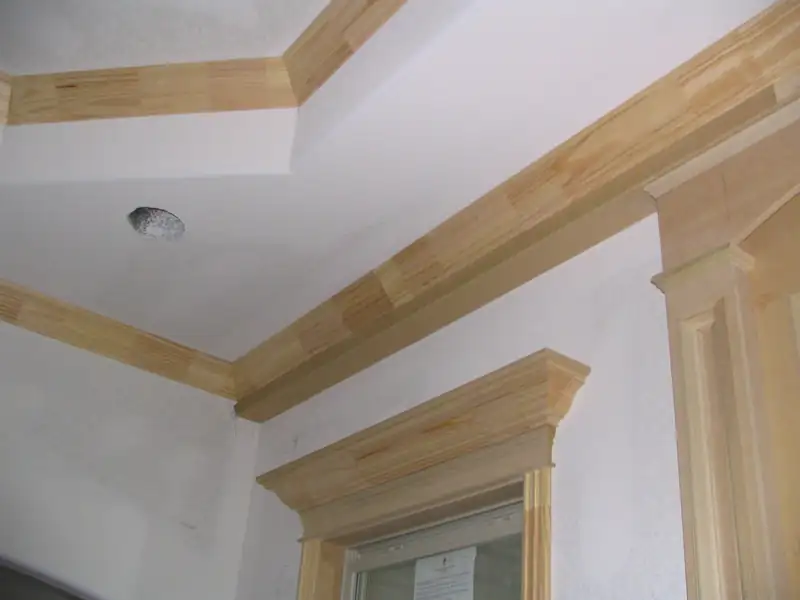
The first photo shows new wood crown molding fitted along a stepped tray ceiling and a matching cap over a window, all still unpainted. Seeing it bare shows how each piece meets its neighbor.
Once painted, the joints disappear.
Profiles that fit Monterey Park homes
Good matches for houses here:
- a plain cove
- a small ogee
- a flat stepped crown
- a crown with a matching frieze board
- a simple crown above kitchen cabinets
Postwar homes tend to look best with clean, simple shapes.
Why corners are coped
According to Wikipedia, coping shapes the end of a molding to fit the contour of the piece it meets, and is used on inside corners while outside corners are mitered. The same article explains that wood shrinks far more in width than in length, so a coped joint hides that movement better than a mitered one.
That is why our inside corners stay tight.
Ceiling lines
Ceilings in many houses are not perfectly flat. We check the line with a laser, then scribe or caulk to close small gaps.
A straight crown on a wavy ceiling looks worse than one that follows it gently.
Wide white crown
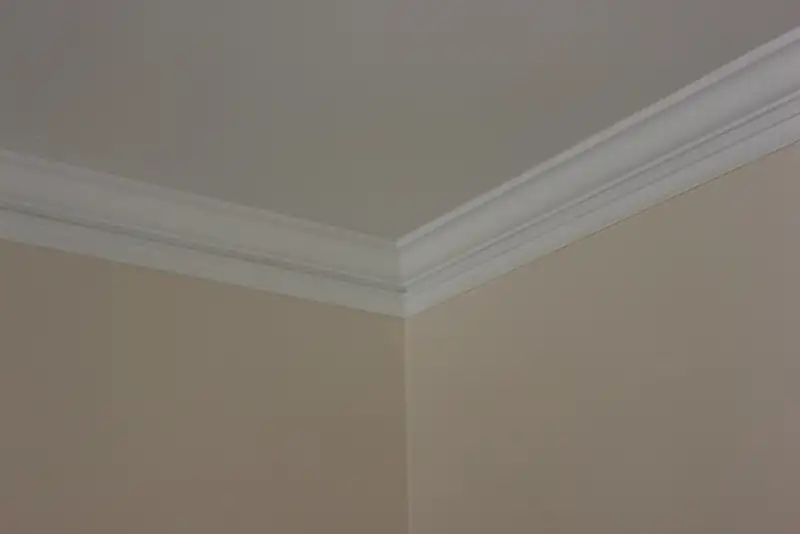
The second photo shows a wide white crown at the corner of a light ceiling. A larger profile like this suits a living room with a higher ceiling. Holding a short sample at the ceiling is the easiest way to judge size, since crown tends to look smaller once it is up. Color matters too: white crown on a white ceiling reads quieter than crown in a contrast color.
In an eight-foot room we usually go a size smaller.
Fastening
Crown is nailed to the wall plates and ceiling joists, with blocking added where needed. Joints are glued.
We locate framing before we start so nails hold.
With the rest of the trim
Matching crown with baseboard and casing makes the room look planned. The trims do not need the same profile, but they look best when their scale and style feel related. A simple crown pairs well with simple casing, and a detailed crown with a more detailed casing. See baseboard installation in Monterey Park and door and trim painting.
For panels lower on the wall, see wainscoting and accent walls.
Kitchens
Crown above upper cabinets closes the gap to the ceiling or caps the cabinet tops. We match the cabinet finish or paint it to the wall.
This works on new or existing cabinets.
Finish
We fill, caulk, prime and paint. A crisp line where the crown meets the wall and ceiling is what makes the job look professional.
We protect floors and furniture throughout.
Painted detail up close
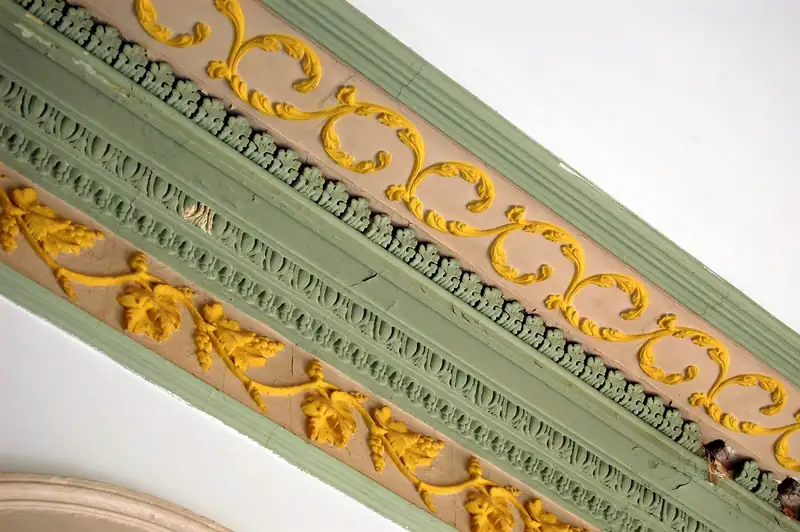
The third photo shows a close view of an ornate crown painted soft green with gold scroll work. Detailed molding like this is more common in grand old buildings than in homes.
If you love the look, a painted accent stripe on a simpler crown is a gentler version.
Scope
We install trim only. Moving lights, adding wiring and structural ceiling work are not part of this job.
Small ceiling cracks are patched before the crown goes up.
Bedrooms and halls
Crown is not only for living rooms. In a Monterey Park bedroom, a small cove gives the ceiling a soft edge, and in a long hall a slim crown makes the space look finished from end to end.
Halls are often where the ceiling is least level, so we take extra care with scribing there.
If budget is a concern, start with the rooms guests see first and add the rest later; the profile can be matched exactly.
What to have ready
Before we start, clear shelves and wall art near the ceiling line and move furniture away from the walls. We cover what stays.
Decide on the paint color for the crown ahead of time so priming and painting can follow straight after installation.
Cost
Price follows the profile, the length of crown, the number of corners and whether we paint. You get a written quote.
How long it takes depends on the job.
Related pages
- Bathroom remodel in Monterey Park
- Kitchen remodel in Monterey Park
- Tub-to-shower conversion in Monterey Park
- Shower remodel in Monterey Park
- Kitchen cabinet replacement in Monterey Park
- Flooring installation in Monterey Park
- Countertop replacement in Monterey Park
- Backsplash installation in Monterey Park
- Interior painting in Monterey Park
- Leaking shower pan repair in Monterey Park
- Powder room remodel in Monterey Park
- Bathtub replacement in Monterey Park
- Bathroom tile installation in Monterey Park
- Tile floor installation in Monterey Park
- Grout repair in Monterey Park
- Kitchen sink and faucet replacement in Monterey Park
- Drywall patching and repair in Monterey Park
- Walk-in shower in Monterey Park
- LVP flooring installation in Monterey Park
- Toilet replacement in Monterey Park
- Baseboard installation and replacement in Monterey Park
- Shower and tub recaulking in Monterey Park
- Interior door and trim painting in Monterey Park
- Talavera and Spanish tile installation in Monterey Park
- Wainscoting and accent walls in Monterey Park
- Fireplace surround tile in Monterey Park
- Crown molding installation in Alhambra
- Crown molding installation in Rosemead
- Crown molding installation in San Gabriel
- Crown molding installation in Temple City
Materials and styles
- Sage, terracotta and deep blue cabinets
- Granite countertops
- Butcher block countertops
- LVP vs tile flooring
- Victorian tile
- Basketweave tile
- Mosaic tile
- Quarry tile
- Stacked stone
- Hexagon tile
- Terrazzo tile
- Herringbone tile
- Backsplash tile ideas
- Shower tile ideas
- Quartz countertops
- Spanish tile bathroom
- Saltillo tile
- Zellige tile backsplash
- Talavera tile
- Cement tile bathroom floor
- Terracotta tile floors
- Bathroom color trends
- Porcelain wood-look tile
- Subway tile vs handmade tile
- Porcelain vs ceramic tile
- LVP vs laminate flooring
- Semi-gloss vs satin paint
- MDF vs wood trim
- Natural stone and marble bathroom tile
- Grout types: cement, epoxy, urethane